Quick Answer
Pharmacy rack cost planning means estimating your total spend on racks, delivery, installation and a safety buffer before you ask anyone for a quotation. In India, a small medical store of 300–500 sq. ft. typically budgets about ₹80,000 to ₹2,50,000 for racks including installation. Wall-mounted units start near ₹3,000 per unit, and gondola or custom units can reach ₹35,000 to ₹80,000+. The final figure depends on size, steel thickness, finish, customisation and quantity.
All prices in this guide are indicative market ranges. Steel rates and specifications change, so always confirm with a written quotation.
Why Cost Planning Matters Before You Buy
Racks are one of the largest one-time expenses when you open or renovate a medical store. They also affect how fast you dispense, how easily staff find medicines, and how professional your store looks to patients.
Most budget problems do not come from the rack price itself. They come from what was never counted: transport, installation, extra shelves, layout changes or replacing weak racks after two years. A clear plan up front prevents all of this.
This guide walks you through the process in eight steps.
Step 1: How to Calculate Your Pharmacy Rack Budget
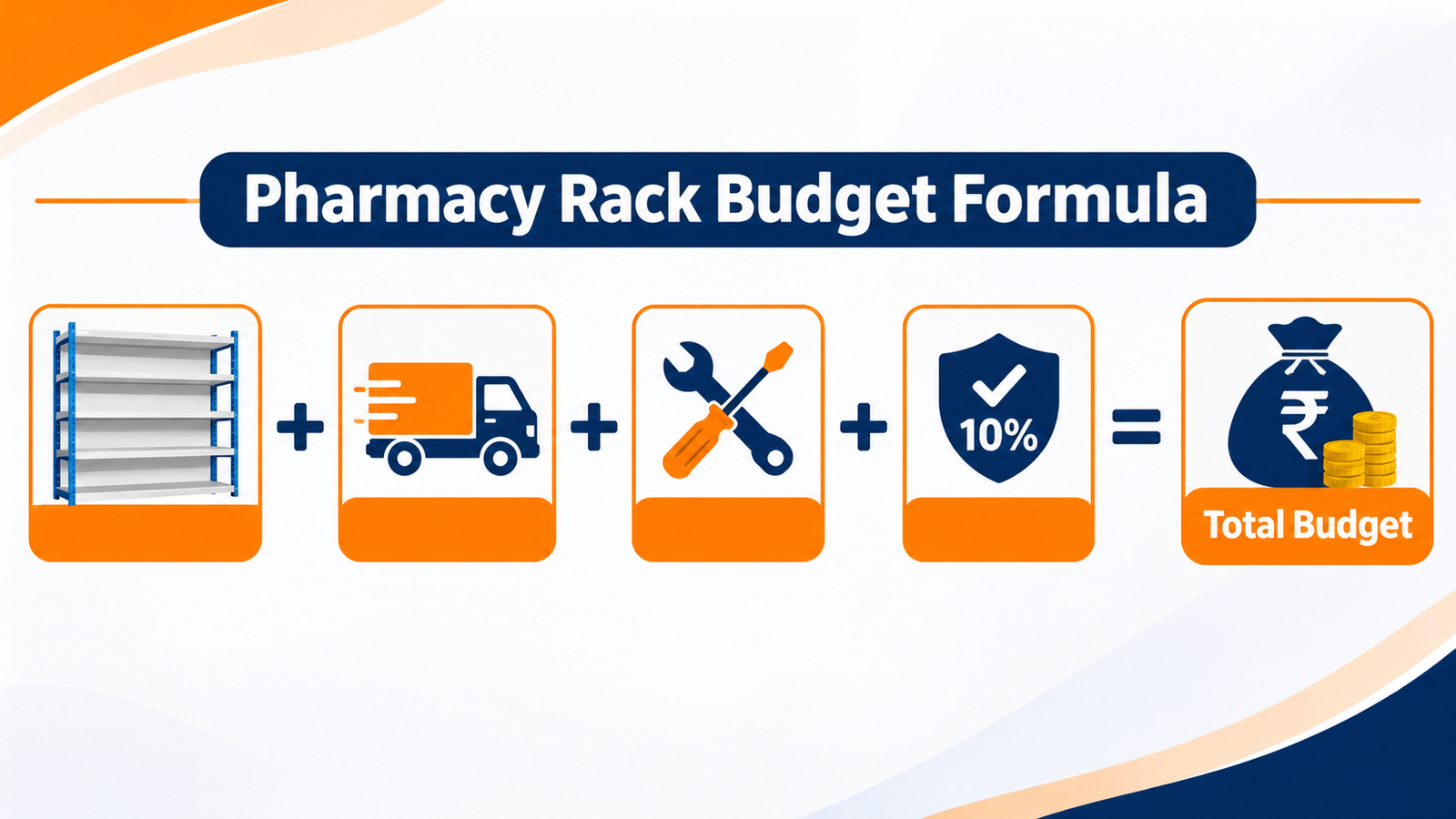
A realistic pharmacy rack budget has five parts, not one.
Total Budget = (Number of racks × Price per rack) + Transport + Installation + Contingency (about 10%)
How to apply it:
- Measure your store. Note carpet area, wall lengths, ceiling height and door width. Racks must fit through the entrance.
- Divide the store into zones. Most pharmacies have a dispensing area, an OTC and self-service area, back storage and a billing counter.
- Choose a rack type for each zone. Wall-mounted racks suit the walls, gondolas suit the centre, and drawer units suit backend and prescription storage.
- List quantities and sizes. Write the exact count and dimensions for each type.
- Add logistics and a buffer. A 10% contingency covers extra shelves, small layout changes or price movement.
Sample medical store rack cost estimate (illustrative, 400 sq. ft. store):
| Item | Qty | Approx. Rate | Subtotal |
| Wall-mounted racks | 6 | ₹6,000 | ₹36,000 |
| Gondola racks | 4 | ₹12,000 | ₹48,000 |
| Drawer storage racks | 2 | ₹8,000 | ₹16,000 |
| Rack total | ₹1,00,000 | ||
| Transport + installation | ~₹10,000 | ||
| Contingency (10%) | ~₹11,000 | ||
| Estimated budget | ≈ ₹1,21,000 |
This is a planning example only. Your real number will change with your specifications.
Step 2: How Rack Size and Dimensions Affect Cost
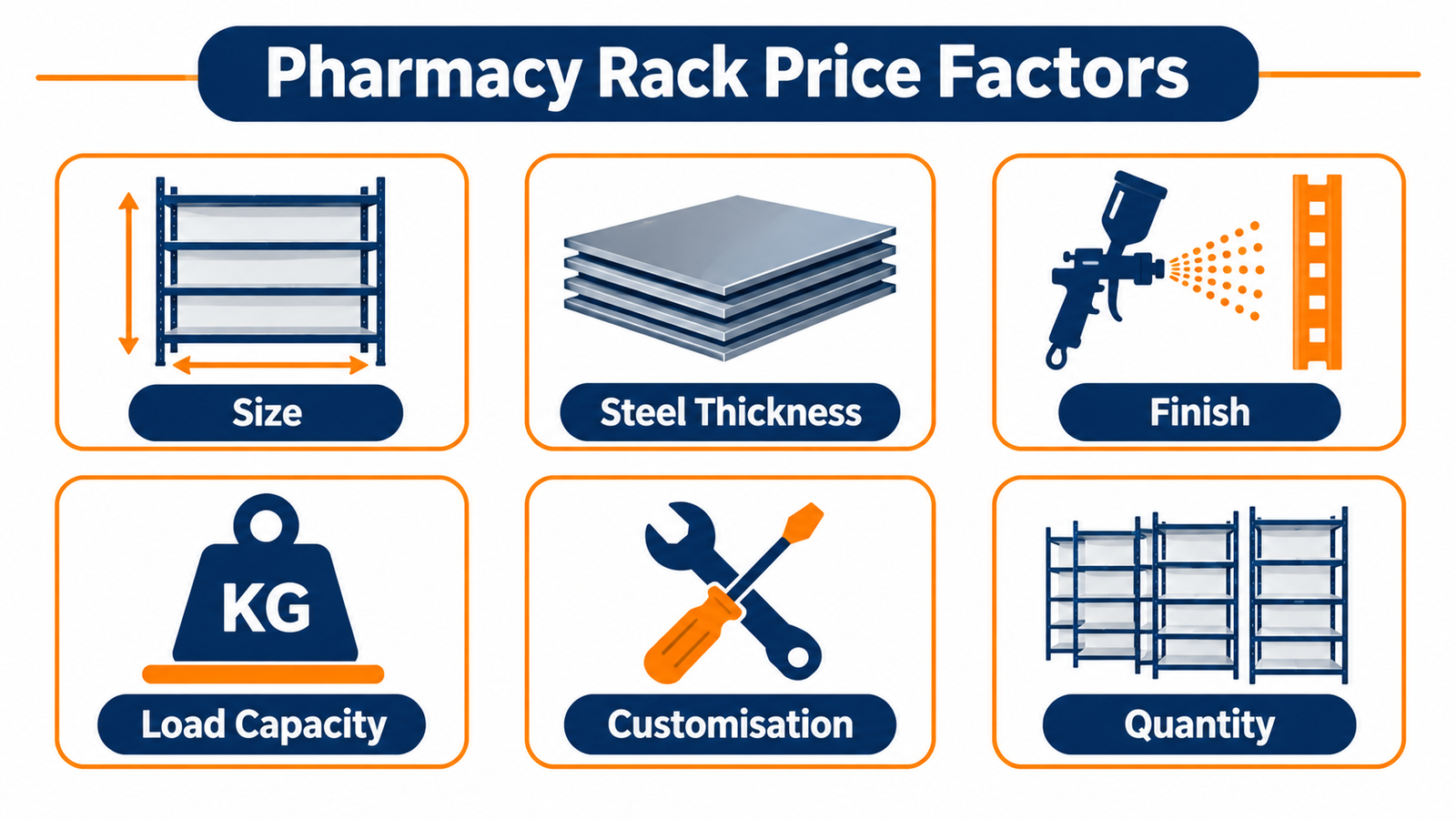
Price follows the amount of steel used and the fabrication time. Size is therefore one of the biggest pharmacy rack price factors.
- Height: Standard heights (5 ft, 6 ft and 7 ft) are cheaper than non-standard heights because they use common cutting and production patterns.
- Width and depth: Wider or deeper shelves need more material and extra reinforcement so they don’t sag.
- Number of shelves: Every extra shelf adds steel, brackets and finishing work.
- Single-sided vs double-sided: A double-sided gondola costs more than a wall unit, but it displays more products per square foot of floor space.
- Load capacity: Shelves rated for 80–150 kg need thicker sections than shelves rated for 20–30 kg.
Budgeting tip: Size your racks around your actual stock, such as syrup bottles, strips, cartons and cold-chain items. Paying for extra height or depth you won’t use is wasted money.
Step 3: MS Material, Thickness and Finish Pricing Factors
Two racks can look identical in photos and still differ widely in price. The reasons are usually in the material and finish.
MS (mild steel) type: Cold-rolled steel gives a smoother surface and better finish quality than basic alternatives. It costs a little more but performs better in daily use.
Thickness or gauge: This matters more than almost anything else. Thicker steel carries more weight and lasts longer. A 16-gauge section is stronger than a 20-gauge one. Ask for thickness in millimetres or gauge for both the frame and the shelf.
Finish: Electrostatic powder coating adds to the cost, but it resists rust, keeps its colour and is easy to wipe clean. In humid weather, a weak finish can corrode within a year or two.
Joints and brackets: Reinforced, well-fixed joints reduce bending over time.
Add-ons: Glass panels, LED lighting, branding panels and drawers each raise the final rate.
Metal vs wood (indicative):
| Feature | Steel Racks | Wooden Racks |
| Typical life | 10–20 years | 5–10 years |
| Maintenance | Low | Medium |
| Load capacity | High | Moderate |
| Best for | Most medical stores | Premium-look stores |
For most medical stores, powder-coated steel gives the best value over time.
Step 4: Standard vs Customised Rack Budgeting
Your choice here changes your budget more than any other single decision.
Standard racks come in common sizes. They are cheaper, ready sooner and work well for regular, rectangular store layouts.
Customised racks are built to your floor plan and branding. They cost more per unit and take longer, but they solve real problems such as corners, narrow spaces and branded OTC zones.
| Standard | Customised | |
| Cost per unit | Lower | Higher |
| Lead time | Shorter | Longer |
| Space fit | General | Exact |
| Branding | Limited | Colour, logo and panels possible |
| Best for | Regular layouts | Irregular or branded stores |
A practical approach: use standard racks along straight walls and in the main floor area, and use custom units only where a standard size would waste space. This mixed approach usually gives the best balance of cost and fit.
If you plan to grow, consider modular shelving. It costs slightly more at the start, but it can be reconfigured or extended later without replacing everything.
Step 5: Number of Racks and Total Budget
Total cost does not rise in a perfectly straight line with the number of racks. Larger orders often get better rates, and the logistics cost is spread across more units.
| Store Size | Typical Setup | Indicative Total (with installation) |
| Small (200–300 sq. ft.) | Wall units, 1–2 gondolas, counter storage | ₹80,000 – ₹1,50,000 |
| Medium (300–500 sq. ft.) | Wall units, 3–5 gondolas, drawer units | ₹1,20,000 – ₹2,50,000 |
| Large or multi-counter | Modular systems, glass displays, custom pieces | ₹2,50,000 – ₹3,00,000+ |
Quantity tips:
- Bulk orders may attract roughly 10–20% discounts, so ask for slab-wise pricing.
- If you will buy in phases, ask whether today’s rate will be held for the second batch.
- Keep the finish, colour and dimensions consistent across phases so the store looks uniform.
- Start with essentials, which are a counter rack, one main gondola and a wall unit. Add more as sales grow.
Step 6: Transportation and Installation Cost Considerations
Many owners compare only the rack price and then get surprised by the final bill. Always ask about these two items separately.
Transportation
- Within Delhi NCR, delivery is often included or kept minimal.
- For other cities, transport can add roughly ₹500 to ₹3,000 per rack depending on weight, distance and packing.
- Confirm who pays for loading and unloading.
- Ask who is responsible if a rack is damaged in transit.
Installation
- For a store of about 500 sq. ft., installation commonly falls between ₹5,000 and ₹20,000, depending on the number of units and the work involved.
- Ask whether wall fixing, levelling and shelf adjustment are included.
- Ask about extra charges if your shop is on an upper floor without a lift.
Also plan for practical details: entrance width, permitted working hours, time needed to shift existing stock, and how long your store will stay closed or partly closed during installation.
Step 7: How to Compare Pharmacy Rack Quotations
Comparing only the final number is the most common budgeting mistake. A low quotation may simply leave out thickness, finish, transport or installation.
The right method: give every seller the same information (store dimensions, layout sketch, rack types, quantity and finish), then compare the replies line by line.
Quotation comparison checklist:
| Check | Seller A | Seller B | Seller C |
| Rack type and exact size (H × W × D) | |||
| Steel type and thickness (mm or gauge) | |||
| Load rating per shelf (kg) | |||
| Finish (powder-coated or painted) | |||
| Shelves per unit | |||
| Price per unit, GST shown separately | |||
| Transport included? | |||
| Installation included? | |||
| Warranty period and coverage | |||
| Delivery timeline | |||
| Payment terms | |||
| After-sales support |
Extra tips:
- Ask for written specifications, not just a price on a message.
- Check finished work. Ask for photos of completed stores, a sample, or a visit to see the finish quality.
- Be careful with the lowest quote. A price far below the others often means thinner steel, basic paint or no installation.
- Compare GST the same way across all quotations.
- Look at support. Ask who will help if you need extra shelves or adjustments later.
Before you request quotes, it helps to finalise your layout. Our Pharmacy Setup Checklist and our guide to pharmacy rack design ideas for small stores will help you do that.
Step 8: Common Mistakes in Pharmacy Rack Purchase Budgeting
1. Choosing only the lowest price.
A ₹2,500 rack and a ₹7,000 rack can look the same in a photo. The difference sits in steel thickness, joints and coating. Cheap racks often bend or rust and get replaced within a couple of years.
2. Not asking for steel thickness.
Thin steel sags under bottles and bulk cartons. Always get the thickness in writing.
3. Leaving out transport and installation.
These costs are real and can change your total noticeably.
4. Having no contingency.
Layout tweaks, extra shelves and small modifications almost always appear during setup.
5. Ignoring future expansion.
If your racks can’t be extended, you may have to replace them when your store grows.
6. Skipping the warranty check.
Get warranty terms in writing, including what is covered and for how long.
7. Buying before measuring.
Wrong dimensions cause wasted space, awkward gaps or even racks that don’t fit through the door.
8. Ignoring total cost of ownership.
A rack that lasts ten years costs far less per year than one you replace every two. Durability, maintenance and scalability all belong in your budget.
Frequently Asked Questions
Q1. How do I plan a pharmacy rack budget?
List your store zones, decide the rack type and quantity for each, multiply by the price per unit, then add transport, installation and about 10% contingency.
Q2. What is the average medical store rack cost in India?
As an indicative range, wall-mounted units cost about ₹3,000 to ₹12,000, and gondola units about ₹8,000 to ₹35,000. A small store setup often falls between ₹80,000 and ₹2,50,000 including installation.
Q3. What are the main pharmacy rack price factors?
Steel thickness, rack size, finish (powder coating), load capacity, customisation and order quantity.
Q4. Are custom pharmacy racks worth the extra cost?
They are worth it when your space is irregular or you need branded, space-optimised storage. For regular layouts, standard racks save money.
Q5. Do rack quotations include installation?
Not always. Ask for transport and installation as separate line items so you can compare honestly.
Q6. How can I get an accurate pharmacy rack cost estimate?
Share your store dimensions, a layout sketch, rack types, quantities and finish preference. A quotation based on real specifications is far more reliable than a general price list.
Final Thoughts
Good pharmacy rack cost planning is simple once you follow the steps: measure your store, choose rack types by zone, understand the price factors, compare standard and custom options, count transport and installation, and compare quotations on specifications rather than price alone.
If you plan carefully, you avoid surprise costs, you buy racks that last, and you build a store that is easy to run and easy for patients to trust.
Get a Quotation for Your Store
Share your store size and layout to receive a detailed estimate. You can browse our pharmacy display racks or call +91-9582199673 for a quotation