

Buying pharmacy racks is not only about looks or price. The steel, shelf construction, load rating and powder coating decide how the racks hold up in daily use. This pharmacy rack quality checklist shows medical store owners in India what to ask, what to inspect and how to compare manufacturers before placing an order.
Quick Answer: How to Check Pharmacy Rack Quality
To check pharmacy rack quality, ask for the steel type and thickness of each component, the load rating per shelf, and the powder-coating details in writing. Then inspect welds, alignment and finish, and compare the delivered racks with the approved drawing before you accept them.
Key Takeaways
- Ask for the steel type and thickness of each component in millimetres, not just “heavy duty”.
- Get a written load rating for each shelf, along with the shelf size it applies to.
- Ask how the metal is cleaned and treated before powder coating.
- Inspect welds, corners, edges and alignment before accepting delivery.
- Choose shelf depth and height from your actual medicine cartons and bottles.
- Compare itemised written quotations, not just the final price.
Pharmacy Rack Quality Checklist: 10 Points to Verify
Use this table when you compare quotations or inspect a delivered order.
| # | Check | What to look for | How to verify |
| 1 | Material | Steel type named for each major part | Written material details in the quotation |
| 2 | Thickness | Separate values (mm) for uprights, shelves, base and back panel | Quotation or technical drawing |
| 3 | Shelf load rating | A kg rating per shelf, for a stated shelf size | Written rating and test method |
| 4 | Shelf supports | Proper brackets, folds and reinforcement | Look at the underside of each shelf |
| 5 | Welding | Neat joints, no cracks or gaps | Visual check of corners and joints |
| 6 | Alignment | Straight uprights, level shelves | Spirit level on a level floor |
| 7 | Powder coating | Even finish with no bare metal | Check edges, corners and weld areas |
| 8 | Shelf size | Depth and height suit your products | Test with real cartons and bottles |
| 9 | Stability | Rack stands firm and can be fixed as needed | Check levelling and fixing points |
| 10 | Paperwork | Specs, warranty and delivery terms in writing | Match the quotation to the delivery |
Need a quote with written specifications? Call Era Display Solutions on +91-9582199673 or email eradisplaysolution@gmail.com.
Pharmacy Rack Material: MS, CR, GI or Stainless Steel?
Most powder-coated pharmacy racks are made from mild steel (MS) or cold-rolled (CR) sheet. The material name matters less than the thickness of each part and the quality of the finish.

| Material | Best suited for | Watch out for | Ask the manufacturer |
| Mild steel (MS) | General powder-coated racks | Thin sections can bend; needs a good coating | Grade and thickness of each part |
| CR sheet | Shelves and panels needing a smooth, even surface | Cut edges and welds still need proper coating | Which parts use CR sheet |
| Galvanised iron (GI) | Places where zinc protection is wanted | Cut and welded areas need care | GI specification supplied |
| Stainless steel | Damp or hygiene-sensitive areas | Higher cost; grades differ | Grade and finish |
Ask for thickness part by part
Uprights, shelves, base panels and back panels do different jobs, so their thickness can differ. Ask for each value in millimetres. If a quote uses gauge, ask for the millimetre equivalent.
As a rough guide, sheet-steel gauge converts like this. Gauge tables vary by material, so confirm the actual figure with the maker.
| Gauge | Approx. thickness |
| 16 gauge | 1.5 mm |
| 18 gauge | 1.2 mm |
| 20 gauge | 0.9 mm |
In light-duty retail racks, shelves are commonly made from sheet of roughly 0.6–1.0 mm with folded edges, and uprights are usually thicker. These are general ranges, not the specification of any one manufacturer. Always compare actual values from written quotes.
Pharmacy Rack Load Capacity: How Much Can Each Shelf Hold?
Load capacity is the maximum weight a shelf is designed to carry under stated conditions. It should be written in kilograms per shelf, not described as “strong” or “heavy duty”.
Check what the rating covers. Ask whether it is for a uniformly distributed load (UDL). UDL means the weight is spread evenly across the shelf, not concentrated in one spot. Also confirm the shelf width and depth, the brackets used, and whether the rating is for one shelf or a full bay.
Shelf span matters. A wider shelf with fewer supports may bend more than a shorter one under the same load. A rating for one size should not be assumed for another.
Example: estimating a medicine shelf load
These weights are illustrative only. Weigh your own stock.

| Stock on one shelf | Illustrative weight |
| 30 medicine cartons at about 0.3 kg | 9 kg |
| 15 syrup bottles at about 0.4 kg | 6 kg |
| Other healthcare products | 5 kg |
| Total | 20 kg |
Compare your own estimate with the manufacturer’s written rating for the exact shelf you plan to buy. Do not load-test a rack yourself with heavy stock. Ask the manufacturer to explain or demonstrate their test method.
Pharmacy Rack Powder Coating: What to Inspect
Powder coating is a finish where dry coating powder is applied to prepared metal and cured with heat. It gives the rack its colour and a protective surface, but only if the metal is prepared well first.
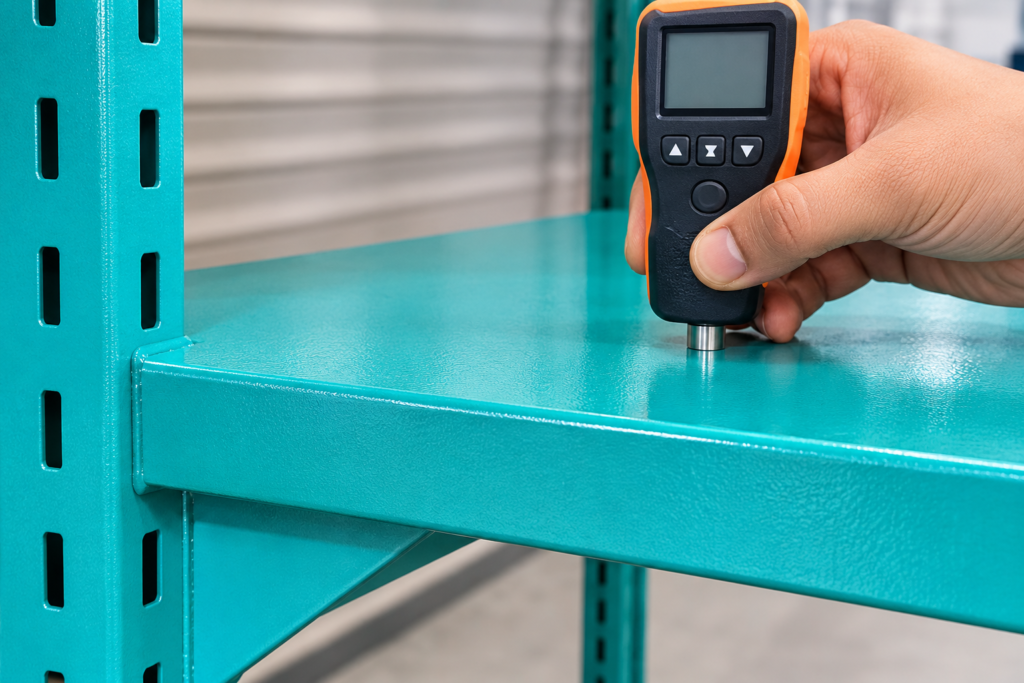
1. Ask about pre-treatment. Metal should be cleaned of oil, dirt and rust before coating, often followed by a chemical treatment. Ask what process is used and whether welds and corners are included.
2. Ask about coating thickness. Thickness is measured in microns (µm). Powder coating on indoor furniture is often specified at roughly 60–80 µm, but this is a general reference only. Ask for the maker’s own value and how it is measured.
3. Ask about testing. Two standards you may hear about:
- ISO 2409 describes a cross-cut test that checks how well a coating resists separating from the metal. It does not measure adhesion strength directly. (ISO)
- ASTM B117 describes how to run a salt-spray (fog) test. It does not set pass or fail limits by itself. (ASTM)
A standard’s name is not proof that a rack passed. Ask for the test report.
4. Inspect by eye. Look at corners, folded edges, weld areas and shelf bends for bare metal, bubbles, scratches, peeling or uneven patches. A visual check finds obvious defects but cannot prove coating thickness or long-term corrosion resistance.
Pharmacy-Specific Checks Before You Order
A pharmacy rack should fit the products you actually stock.
- Shelf depth and height: Measure your regular cartons, syrup bottles and larger packs. Leave enough clearance to pick and replace items easily.
- Label and price holders: Check that labels stay visible once products are arranged, and that holders suit the shelf design.
- Front-end vs back-counter: Front racks are planned around visibility and customer access. Back-counter racks are planned around staff access and stock order. Do not use one design for both. For layout ideas, read our guide to pharmacy rack design ideas for small medical stores.
- Lockable storage: Some medicines may need lockable storage under applicable rules. Confirm requirements with your pharmacist or drug inspector before choosing drawers or cabinets.
Planning the whole store? See our pharmacy setup checklist.
How to Check Rack Quality at Delivery
Compare what arrives with the approved quotation and drawing.

- Verify dimensions. Check height, width, depth and shelf count.
- Inspect the structure. Look for bending, dents or deformation in uprights, shelves and base.
- Check joints and supports. Look at welds, brackets and shelf connections for cracks, gaps or loose parts.
- Inspect the finish. Check for scratches, chips, peeling and bare metal, especially on edges and corners.
- Count the accessories. Match shelves, brackets and fasteners against the order.
Photograph any damage or missing items and report them before you sign off the delivery.
How to Choose a Pharmacy Rack Manufacturer in India
The best way to choose is to compare written specifications, not promises.
- Manufacturing capability: Ask whether the company makes the racks itself or buys finished products. If it fabricates in-house, ask which steps (cutting, bending, welding, coating, assembly) happen at its own unit. Photos or a video walkthrough of the workshop help.
- Relevant work: Ask for photos of completed pharmacy projects and check the finish and neatness of installation.
- Itemised quotation: It should list material, thickness per part, dimensions, shelf count, load rating, coating details, quantity, price, delivery, installation and warranty.
- Warranty and support: Ask what is covered, for how long and how defects are reported. Get it in writing.
- Delivery and installation: Confirm the timeline, and whether unloading and assembly are included or charged separately.
Manufacturer vs local fabricator
Both can make good racks. Compare what each will actually commit to in writing.
| Point | What to verify |
| Production | Which processes are done in-house? |
| Specifications | Are material, thickness and dimensions written down? |
| Finish | Is the coating process explained? |
| Customisation | Which sizes and layouts are possible? |
| Delivery | Is the schedule confirmed? |
| After-sales | Are warranty and support terms documented? |
For more on this, read our page on manufacturer vs supplier.
About Era Display Solutions. We are a display rack manufacturer based in Mayur Vihar, Delhi. We make pharmacy display racks along with supermarket, grocery and retail racks, and serve buyers across Delhi NCR and India. Medical stores that also need wall shelving or a counter can look at our wall mount display racks, slotted angle racks and billing counters.
Red Flags Before Ordering Pharmacy Racks
- The seller will not state thickness in millimetres.
- “Heavy duty” is claimed with no kg rating per shelf.
- Coating and pre-treatment cannot be explained.
- The quote has no dimensions, shelf count or item-wise price.
- Warranty, delivery or installation terms stay verbal.
- You are pushed to pay in advance before specifications are agreed.
One red flag is not proof of poor quality. Ask questions and compare the answers with the written quotation.
Frequently Asked Questions
1. How do I check the quality of a pharmacy rack?
Check the material, thickness of each part, shelf supports, welding, alignment, load rating and powder-coated finish. Compare the delivered rack with the approved drawing and quotation.
2. What steel thickness should a pharmacy rack have?
Ask for thickness in millimetres for each part, because uprights, shelves and panels differ. As a reference, the 18-gauge sheet is about 1.2 mm and the 20-gauge is about 0.9 mm.
3. How much weight can a pharmacy rack shelf hold?
It depends on shelf size, thickness, reinforcement and support
\
. Ask for a written kg rating for the exact shelf, and estimate your own stock first. A shelf of cartons, bottles and supplies can easily reach around 20 kg.
4. What powder coating thickness is good for pharmacy racks?
Indoor powder coating is often specified at roughly 60–80 microns, but this is only a general reference. Ask the manufacturer for its own specified value and how it is measured.
5. Which material is best for pharmacy racks?
Mild steel and CR sheet with a good powder-coated finish are common choices. GI or stainless steel may suit special needs. Ask which material is used in each part.
6. What should I check before accepting delivery?
Check five things: dimensions, structure, joints, finish and accessories. Photograph any damage or missing parts and report them before signing off.
7. Should I choose a manufacturer or a local fabricator?
Choose whoever can show clear written specifications, finishing quality and after-sales terms. The label alone does not guarantee quality.
Conclusion
A good pharmacy rack matches your products, carries the load you expect and keeps its finish in daily use. Use this pharmacy rack quality checklist to compare quotations, ask the right questions and inspect your delivery.
To discuss your store’s rack requirement, contact Era Display Solutions: Plot No. C21, GF, Khasra No. 13, Gali No. 3, Kotla Village, Mayur Vihar, Delhi 110091. Phone: +91-9582199673, +91-9818867220. Email: eradisplaysolution@gmail.com.