
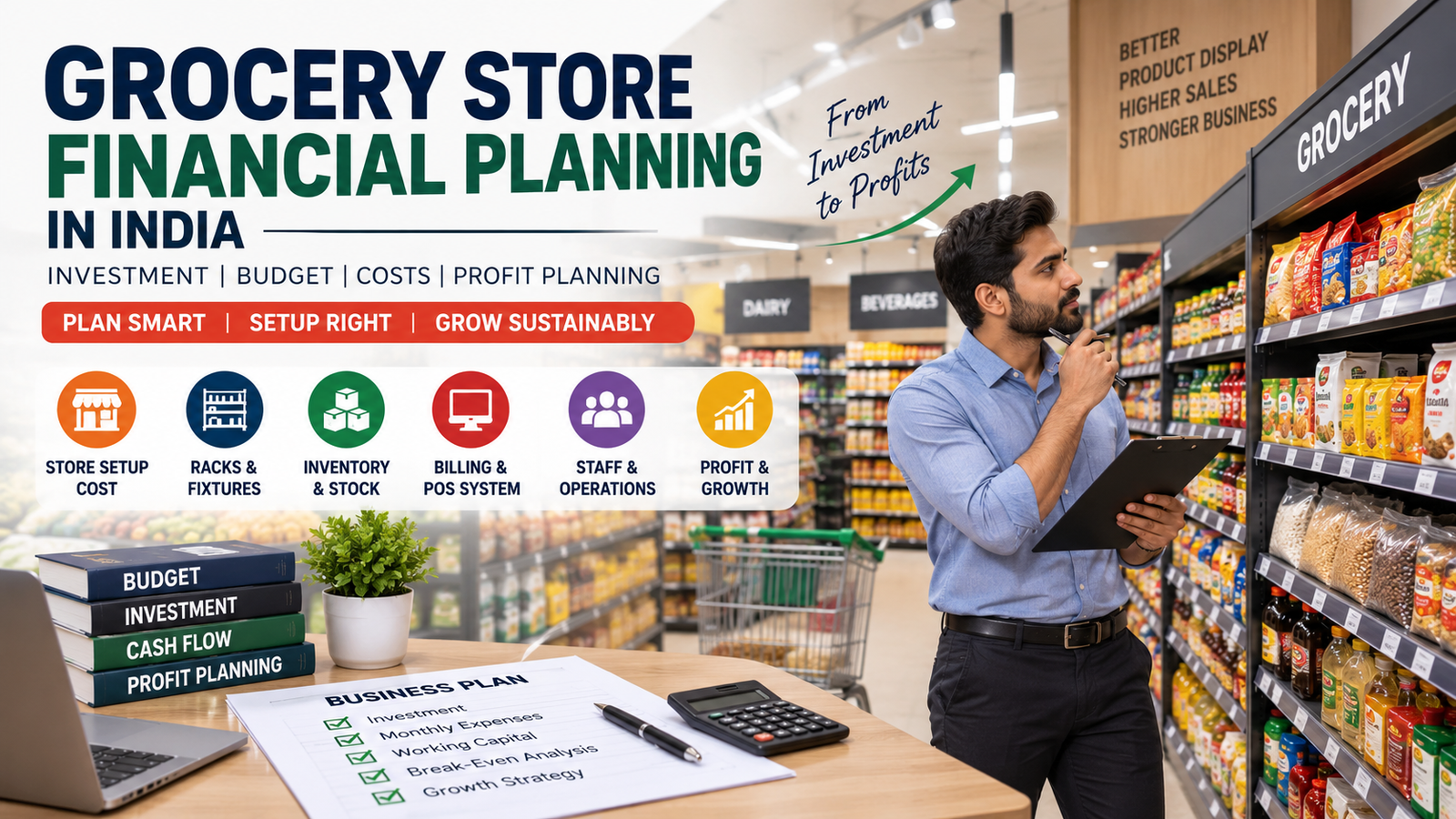
Opening a grocery store requires more than arranging products and finding a suitable shop. Proper grocery store financial planning helps estimate the initial investment, monthly expenses, inventory requirements, working capital and the sales needed to make the business sustainable.
The total investment can vary significantly depending on the store size, location, rent, inventory range, equipment, fixtures and business model. A small neighbourhood grocery store will have very different financial requirements from a larger supermarket.
This guide explains the major costs involved in starting a grocery store in India and how to create a practical budget before investing.
Quick Answer: Grocery store financial planning involves estimating startup costs, monthly operating expenses, inventory investment, working capital and expected sales. Major expenses can include rent and security deposit, interiors, grocery store racks, refrigeration, POS systems, initial inventory, licences, signage, staff and marketing.
Key Takeaways
- Grocery store investment in India varies depending on store size, location, rent, inventory, equipment, fixtures and working-capital requirements. There is no single investment amount that applies to every grocery store.
- A grocery store business budget should include both initial setup costs and recurring monthly expenses to understand the total financial requirement.
- Major startup expenses can include rent and security deposit, interiors, grocery store racks, refrigeration, POS systems, initial inventory, licences, signage and marketing.
- Grocery store working capital is important for managing inventory replenishment and day-to-day operating expenses after the store opens.
- Small grocery store investment can be lower than that of a larger supermarket, but efficient space utilisation and product display remain important.
- Grocery store racks and fixtures should be selected according to the store’s dimensions, product categories, load requirements and planned layout.
- A grocery store break even calculation can help estimate the sales required to cover fixed and variable operating costs.
What Is Grocery Store Financial Planning?
Grocery store financial planning is the process of estimating how much money is required to start, operate and maintain a grocery store.
A practical financial plan should consider three major areas:
- Initial investment – money required before or around the time the store opens.
- Monthly operating expenses – recurring costs required to run the store.
- Working capital – money kept available to manage inventory purchases and operating expenses before sufficient cash flow is generated.
The purpose is not simply to calculate how much money is needed to open the shop. A good plan should also answer questions such as:
- How much inventory should be purchased initially?
- How much should be allocated to store interiors?
- How much space should be used for product display?
- How much should be reserved for working capital?
- What will the monthly operating cost be?
- How much sales revenue is required to cover expenses?
- How much should be spent on racks and fixtures?
This approach can prevent a common mistake: spending most of the available capital on opening the store and leaving too little cash for inventory replenishment and monthly expenses.
How Much Does It Cost to Start a Grocery Store in India?
There is no single fixed figure for grocery store setup cost in India.
The grocery store opening cost depends on factors such as:
- Store size
- City and locality
- Monthly rent
- Security deposit
- Interior requirements
- Number and type of racks
- Refrigeration requirements
- Initial inventory
- Billing and POS equipment
- Signage
- Staff requirements
- Licences and registrations
- Working capital
For example, a small neighbourhood store operating from a compact rented space may require a substantially different investment from a larger self-service supermarket with extensive product categories and refrigeration.
Therefore, instead of relying on a single generic investment figure, the business owner should prepare a cost sheet based on the actual store size and operating model.
For a broader breakdown of supermarket-related investment, readers can also refer to the supermarket setup cost in India guide.
Grocery Store Investment Breakdown
A useful grocery store investment plan should divide expenses into clear categories.
1. Shop Rent and Security Deposit
Rent is usually one of the largest recurring expenses.
Before finalising a location, calculate:
- Monthly rent
- Security deposit
- Maintenance charges
- Electricity deposit, if applicable
- Other property-related charges
A location with high footfall may generate stronger sales potential, but a significantly higher rent can also increase the monthly break-even requirement.
The objective should be to find a balance between customer accessibility, expected sales and occupancy cost.
2. Interior Work
Interior expenses can include:
- Flooring
- Ceiling work
- Lighting
- Wall finishing
- Electrical work
- Counter area
- Storage area
- Signage
- Basic customer-facing fixtures
The interior budget should be based on the store’s requirements rather than spending heavily on decorative elements that do not contribute to product presentation or customer movement.
For a grocery store, practical layout and efficient product display are often more important than expensive decorative interiors.
3. Grocery Store Racks
Racks are an important part of the physical infrastructure of a grocery store.
The investment depends on:
- Number of racks required
- Rack dimensions
- Number of shelves
- Load requirements
- Material and finish
- Wall-mounted versus gondola-style arrangements
- Product categories
- Available floor space
A well-planned rack layout can help make better use of vertical space while maintaining reasonable customer movement through the store.
When planning the budget, the number of racks should be estimated after deciding the store layout, rather than purchasing racks first and trying to fit them into the available space.
For stores looking for purpose-built grocery store racks, ERA Display Solutions provides product options designed for retail product display.
4. Display Fixtures
Depending on the store format, additional fixtures may be required for:
- Promotional products
- Fruits and vegetables
- Dairy products
- Personal care products
- Household products
- Bulk items
- Checkout-area merchandise
The objective is to select fixtures according to the product categories and available space.
5. Refrigeration
Stores selling dairy products, frozen foods, beverages and other temperature-sensitive products may require refrigeration equipment.
Potential costs include:
- Display refrigerators
- Freezers
- Cold storage
- Electrical installation
- Maintenance
Refrigeration requirements should be estimated based on the product mix rather than assuming every grocery store requires the same equipment.
6. Billing and POS System
A grocery store may require:
- POS software
- Barcode scanner
- Billing computer or terminal
- Receipt printer
- Cash drawer
- Barcode printer, if required
- Inventory management software
The system should be selected according to the size and complexity of the store.
For a small store, a basic billing system may be sufficient. A larger supermarket may need stronger inventory and reporting capabilities.
7. Initial Inventory
Inventory can represent a significant portion of the initial investment.
The opening stock may include:
- Staples
- Packaged food
- Beverages
- Dairy products
- Snacks
- Personal care products
- Cleaning products
- Household products
- Other locally relevant categories
Instead of purchasing large quantities of every product, the initial inventory should be based on expected customer demand, product shelf life, supplier terms and available working capital.
8. Licences and Registrations
The registrations and approvals required can depend on the business structure, activities and location.
For businesses dealing with food, FSSAI provides the official food-business licensing and registration system through its digital platforms. The applicable requirement should be checked according to the nature and scale of the business.
FSSAI official food business portal
A business owner may also consider Udyam registration where applicable. The official Udyam portal states that MSME registration is free and paperless.
Official Udyam Registration Portal
Other requirements can vary by state, municipality and business structure, so they should be verified with the relevant authorities before opening.
9. Signage and Branding
The initial setup may also include:
- Store name board
- Interior signage
- Category boards
- Promotional displays
- Price communication
- Basic branding material
Signage should make it easy for customers to identify product categories and navigate the store.
10. Marketing
A new grocery store may allocate part of its opening budget towards:
- Local signage
- Google Business Profile
- Local digital marketing
- Opening offers
- Flyers
- Social media
- Customer referral offers
The marketing budget should be realistic and should not consume money needed for inventory or working capital.
Grocery Store Business Budget Example
Instead of using a fixed investment figure for every business, a grocery store business budget should be built using actual cost estimates. The following is an illustrative planning estimate for a small-to-medium grocery store. Actual costs can vary based on city, store size, location, supplier terms and equipment requirements.
| Expense Category | Estimated Cost |
|---|---|
| Security deposit + initial rent | ₹1,00,000 – ₹2,00,000 |
| Interior and electrical work | ₹1,50,000 – ₹3,00,000 |
| Grocery store racks | ₹1,00,000 – ₹2,00,000 |
| Refrigeration/freezers | ₹1,00,000 – ₹2,00,000 |
| POS and billing system | ₹30,000 – ₹60,000 |
| Initial inventory | ₹3,00,000 – ₹6,00,000 |
| Licences and registrations | ₹10,000 – ₹25,000 |
| Signage | ₹20,000 – ₹40,000 |
| Launch marketing | ₹20,000 – ₹50,000 |
| Working capital reserve | ₹2,00,000 – ₹4,00,000 |
| Total Initial Requirement | ₹10,30,000 – ₹20,75,000 |
Add this immediately below the table:
Note: These figures are illustrative estimates, not fixed market prices. A smaller neighbourhood grocery store may require less capital, while a larger supermarket, premium location or store with extensive refrigeration and inventory can require significantly more. Before investing, business owners should obtain local quotations for rent, racks, equipment, interiors and inventory and prepare a store-specific budget.
A useful rule for budgeting
Separate expenses into:
One-time or initial costs
and
Recurring monthly costs
This makes it easier to understand how much capital is needed before opening and how much cash must remain available after opening.
Small Grocery Store Investment
A small grocery store investment can be structured differently from a supermarket investment.
A smaller store may have:
- Lower rent
- Fewer employees
- Smaller initial inventory
- Fewer refrigeration units
- Smaller billing setup
- Fewer display fixtures
- More compact product assortment
However, a small store should not automatically mean a poorly planned store.
Limited floor space makes layout planning even more important.
For example, using vertical display space effectively can allow more products to be displayed without unnecessarily increasing the store’s footprint.
This is where selecting suitable grocery store display racks becomes part of financial planning rather than simply an interior decision.
The right rack configuration can influence:
- Available display capacity
- Floor-space utilisation
- Product visibility
- Customer movement
- Number of product categories that can be displayed
Monthly Expenses of a Grocery Store
Startup investment is only one part of the financial plan.
The business owner should also calculate recurring monthly expenses.
Common monthly expenses include:
- Shop rent
- Employee salaries
- Electricity
- Inventory replenishment
- Refrigeration and equipment maintenance
- POS/software costs
- Packaging
- Cleaning
- Marketing
- Internet and communication
- Miscellaneous operating expenses
Some expenses remain relatively stable, while others change with sales volume.
For example, rent may remain fixed for a particular period, whereas inventory purchases generally increase as sales increase.
Tracking these separately helps the owner understand the actual operating cost of the store.
How to Plan Working Capital for a Grocery Store
Working capital is one of the most commonly overlooked parts of grocery store financial planning.
A store can open successfully and still face financial pressure if most of its available cash has already been spent on:
- Interiors
- Equipment
- Racks
- Initial inventory
- Deposits
The business still needs money to purchase replacement stock and pay regular operating expenses.
A working-capital plan should therefore account for:
- Expected monthly operating expenses
- Inventory replenishment requirements
- Supplier payment cycles
- Expected customer sales
- Emergency expenses
- Seasonal changes in demand
The exact working-capital requirement will depend on the store’s sales cycle and supplier terms.
A practical approach is to prepare a monthly cash-flow projection before opening rather than deciding the working-capital amount arbitrarily.
Grocery Store Racks and Fixtures: A Part of the Setup Budget
Grocery store racks should be treated as part of the store’s operational infrastructure.
The right selection depends on the products being displayed and the available space.
Before ordering racks, consider:
Store dimensions
Measure the usable floor area rather than simply using the total shop size.
Product categories
Different products may require different shelf depths, heights or configurations.
Aisle planning
Racks should be arranged to allow customers and staff to move through the store comfortably.
Load requirements
The expected weight of products should be considered when selecting rack specifications.
Vertical space
Using appropriate vertical display space can increase product capacity without expanding the store’s floor area.
Future changes
A flexible rack configuration can make it easier to reorganise products when the product mix changes.
For businesses planning their retail infrastructure, ERA Display Solutions offers [grocery store rack] solutions for product display and store organisation.
How to Calculate the Break-Even Point for a Grocery Store
Break-even analysis helps estimate how much sales revenue is required to cover the store’s costs.
A simplified formula is:
Break-even sales = Fixed Costs ÷ Contribution Margin Ratio
For example, suppose a store has:
- Monthly fixed costs of ₹2,00,000
- Contribution margin ratio of 20%
Then:
₹2,00,000 ÷ 0.20 = ₹10,00,000
The simplified break-even sales requirement would therefore be ₹10 lakh per month under those assumptions.
This is only an illustration. Actual grocery-store calculations should use the business’s real gross margin, fixed expenses, variable costs, wastage, discounts and other operating factors.
Why break-even matters
It helps answer a practical question:
How much does the store need to sell every month before it starts covering its operating costs?
Once the break-even point is understood, the owner can work backwards to estimate:
- Required monthly sales
- Daily sales target
- Average transaction value
- Approximate customer count
- Inventory requirements
Common Grocery Store Financial Planning Mistakes
1. Spending too much on interiors
A visually attractive store is useful, but excessive spending on decoration can reduce the capital available for inventory and working capital.
2. Ignoring working capital
Opening-day expenses are not the end of the investment.
The store needs cash after opening as well.
3. Buying too much inventory
More inventory does not automatically mean better sales.
Slow-moving products can lock up capital and increase the risk of expiry or damage.
4. Not calculating monthly expenses
A business owner should know the minimum monthly sales required to keep the store operational.
5. Buying racks without planning the layout
Racks should be selected after understanding:
- store dimensions
- product categories
- aisle requirements
- storage needs
- expected product quantity
6. Using one investment figure for every store
A grocery store in a high-rent urban market and a small neighbourhood store cannot realistically have the same financial requirements.
7. Forgetting maintenance and unexpected costs
Equipment repairs, electrical work, damaged inventory and other unexpected expenses should be considered in the financial plan.
Grocery Store Financial Planning Checklist
Before opening the store, review the following:
- Shop location selected
- Rent and security deposit calculated
- Store measurements completed
- Interior budget prepared
- Rack requirement estimated
- Refrigeration requirement calculated
- POS/billing system selected
- Initial inventory budget prepared
- Licences and registrations checked
- Signage budget prepared
- Monthly operating expenses calculated
- Working capital reserved
- Break-even sales estimated
- Emergency fund considered
- Supplier payment terms reviewed
A simple checklist like this can prevent important costs from being overlooked before the store opens.
Frequently Asked Questions
How much investment is required to start a grocery store in India?
The investment varies according to store size, location, rent, inventory, equipment, racks, fixtures and working-capital requirements. There is no single investment amount that applies to every grocery store.
What is included in grocery store setup cost?
Grocery store setup cost can include rent and deposit, interiors, racks, display fixtures, refrigeration, POS equipment, initial inventory, signage, licences and working capital.
What is the biggest expense when opening a grocery store?
There is no universal answer because the cost structure depends on the store model. Inventory, rent/deposit, interiors, equipment and fixtures can all represent significant portions of the initial investment.
How much should I spend on grocery store racks?
The rack budget depends on the store’s size, layout, number of product categories, required shelf capacity and rack specifications. It is better to calculate the rack requirement from the store layout rather than using a fixed percentage of the total investment.
What is small grocery store investment?
Small grocery store investment refers to the capital required to establish and operate a smaller-format grocery outlet. The main costs can include rent/deposit, basic interiors, racks, initial inventory, billing equipment, licences and working capital.
How much working capital does a grocery store need?
The required working capital depends on monthly expenses, inventory turnover, supplier payment terms, sales volume and the time required for the store to generate consistent cash flow. A monthly cash-flow projection is a better way to estimate it than using a universal figure.
Are grocery store racks part of the initial investment?
Yes. Grocery store racks and other display fixtures are normally part of the physical setup investment because they determine how products are organised and displayed inside the store.
Final Thoughts
Successful grocery store financial planning is not about finding one fixed investment figure. It is about understanding where the money will go before the store opens and how much cash will be required after opening.
A practical plan should account for the initial setup, inventory, racks and fixtures, equipment, monthly operating expenses, working capital and break-even sales.
For a grocery store, the physical layout also has a direct relationship with financial planning. The right grocery store racks can help organise product categories, use available space efficiently and create a more practical retail environment.
Before purchasing fixtures or committing the full investment, measure the store, define the product categories and prepare the layout. Then allocate the rack and fixture budget according to the actual requirements of the store.