

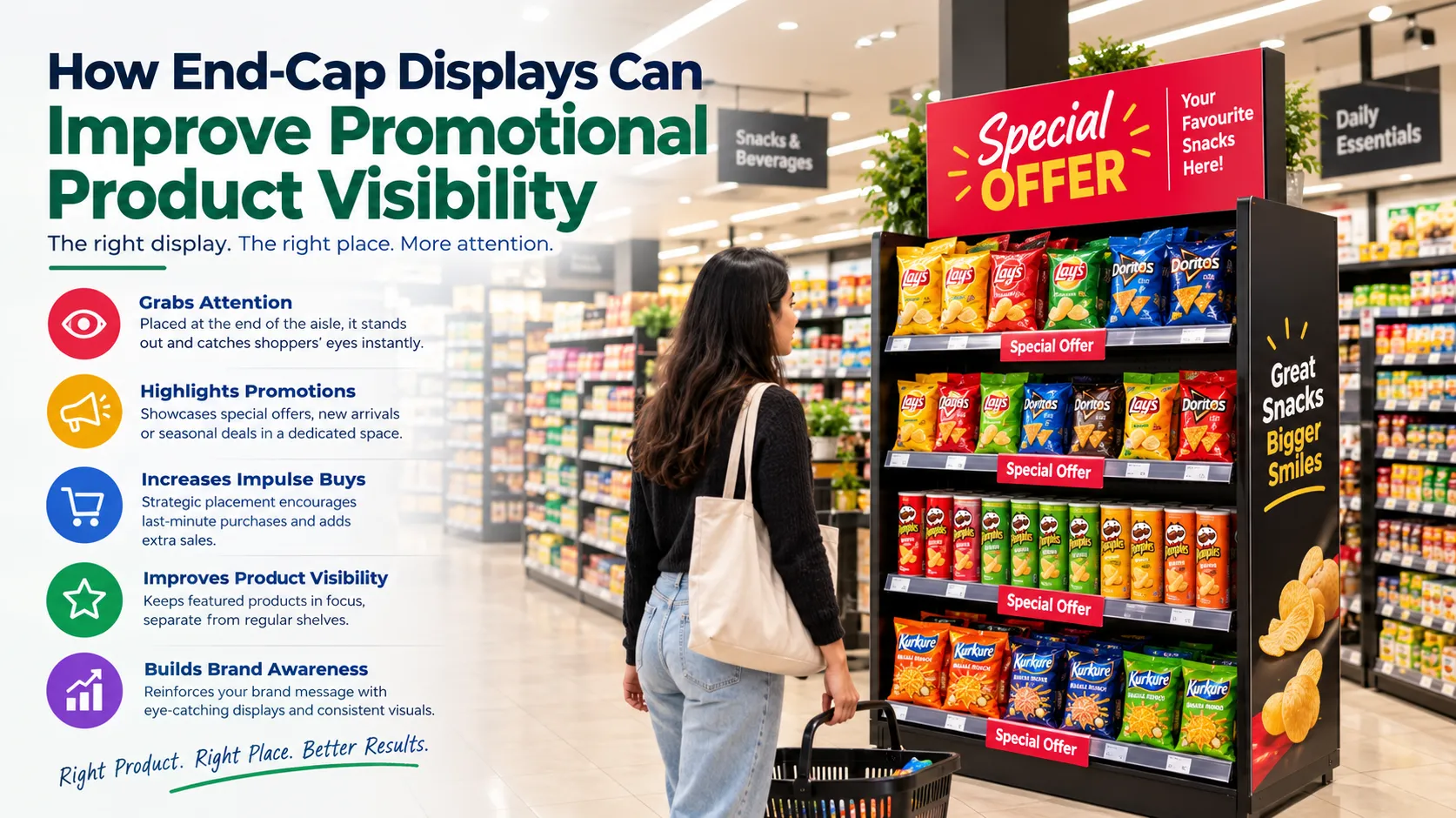
End cap displays for promotional products give retailers a dedicated location to highlight selected merchandise in a busy retail store. When a new product, seasonal offer, limited-time deal, or featured item competes with hundreds of other products, its placement can influence how easily shoppers discover it.
End-cap displays for promotional products provide a dedicated position at the end of a retail aisle, allowing selected products to stand apart from their normal shelf location. When planned properly, an end-cap can combine product placement, clear messaging, accessibility, and timely promotions in one visible area.
For retailers, the goal is not simply to fill an end-cap with products. The display should make the promotion easy to understand, easy to access, and relevant to the shoppers moving through that part of the store.
What Are End-Cap Displays in Retail?
An end-cap display is a product display positioned at the end of a retail aisle, usually where the aisle meets a main customer pathway. Unlike products placed within a standard shelf run, an end-cap gives selected merchandise a dedicated display position.
Retailers commonly use promotional end cap displays for:
- New product launches
- Seasonal merchandise
- Limited-time offers
- Festival promotions
- Featured grocery products
- High-priority products
- Complementary product combinations
- Clearance or special offers
For retailers planning a larger store, understanding the different types of supermarket racks can also help when deciding how end-of-aisle and regular product displays should work together.
Where Are End-Cap Displays Located?
End caps are generally positioned at the visible ends of gondola or shelving runs. Their effectiveness depends partly on where those aisles connect with customer circulation routes.
A retailer may place an end-cap near:
- A main aisle
- A high-traffic intersection
- A category entrance
- A checkout approach
- A frequently visited product section
The location should support the promotion rather than simply occupying an empty space.
Why Are End Caps Different From Regular Shelves?
Regular shelves are primarily designed to organize and store products within a category. An end-cap, on the other hand, can give a selected product or promotion a more dedicated presentation.
This makes the end-cap useful when a retailer wants shoppers to notice something specific without searching through an entire product category.
Why Are End-Cap Displays Useful for Promotional Products?
The main advantage of an end-cap is that it gives promotional merchandise a dedicated position outside its usual shelf location.
End-cap displays can improve retail product visibility by separating featured merchandise from the surrounding products and presenting it in a location that shoppers encounter while moving through the store.
Retail product placement depends on factors such as store layout, customer movement and product visibility. Shopify’s retail product placement guide also discusses endcaps as a prime retail display location.
This can be particularly useful when retailers want to highlight:
- A new product
- A temporary discount
- A seasonal collection
- A promotional bundle
- A product launch
- A high-priority item
Retail merchandising is not only about where a rack is installed. Product grouping, visibility and the way merchandise is presented also matter. Retailers can explore these ideas further in our guide on display racks that increase sales.
Internal link placement: Link the anchor to the actual “Display Racks That Increase Sales” article URL once confirmed. Do not use the homepage if that article has a separate URL.
An end-cap does not automatically make every product successful. Product relevance, pricing, signage, stock availability, store traffic, and display execution also influence the outcome.
Which Products Work Well on Promotional End Cap Displays?
Not every product needs an end-cap. Retailers should select products that have a clear promotional reason for being featured.
New Product Launches
New products can use an end-cap to introduce shoppers to merchandise they may not yet know.
A simple product arrangement combined with clear information can help shoppers understand what is being promoted.
Seasonal Products
Seasonal products are natural candidates for end-cap merchandising.
Examples include:
- Summer beverages
- Winter essentials
- School supplies
- Festival products
- Holiday-related grocery items
The display can be changed when the season or campaign changes.
Limited-Time Offers
A temporary promotion can benefit from a dedicated position because shoppers can identify the offer without navigating through the regular shelf arrangement.
High-Margin or Priority Products
Retailers may also use end caps to feature selected products that are important to a particular promotional campaign.
The decision should be based on the retailer’s commercial objective rather than assuming that every high-margin product belongs on an end-cap.
Complementary Products
An end-cap can also bring related products together.
For example, a retailer could create a themed display around:
- Breakfast products
- Baking essentials
- Party supplies
- Cleaning products
- School stationery
This approach can make the display more useful than simply placing unrelated discounted products together.
How End Cap Displays for Promotional Products Support Seasonal Promotions
Effective end cap merchandising starts with the promotional objective.
1. Choose One Clear Promotional Objective
First decide what the display is supposed to achieve.
For example:
- Introduce a new product
- Promote a seasonal item
- Move selected inventory
- Highlight a special offer
- Encourage complementary purchases
A clear objective makes the rest of the display easier to plan.
2. Choose the Right Product
Select products that are relevant to the shoppers who use that particular aisle or section.
A household cleaning promotion may make sense near household products, while a festival-food promotion may be more relevant in a grocery section.
3. Select the Right Store Location
Consider customer movement before selecting the end-cap.
An end-cap near a frequently used pathway may provide a different opportunity from one located in a less-visited part of the store.
4. Decide Product Quantity and Arrangement
Avoid filling every available area simply because space is available.
Products should remain:
- Visible
- Organized
- Easy to reach
- Easy to identify
- Easy to replenish
5. Add Clear Promotional Messaging
A shopper should be able to understand the promotion quickly.
Depending on the campaign, messaging may include:
- Product name
- Offer
- Price
- Promotion period
- Key benefit
- Bundle information
Keep the message simple enough to understand while walking past the display.
6. Keep Products Easy to Reach
Visibility is only useful if customers can access the products easily.
Product placement should allow shoppers to pick up an item without creating unnecessary obstruction around the aisle.
7. Monitor Stock and Replenishment
A well-planned promotional display can lose its impact if products remain out of stock or the display becomes untidy.
For temporary campaigns, retailers should decide in advance who will check stock and replenish the display.
End-Cap Merchandising: How to Arrange Products for Better Visibility
Good end cap merchandising is about creating a clear visual hierarchy rather than placing as many products as possible in one location.
Use a Clear Visual Hierarchy
Give the shopper an obvious starting point.
A typical arrangement might include:
- Featured product
- Supporting products
- Promotional information
- Related products
This helps the display communicate one clear message.
Avoid Overcrowding
Too many products can make an end-cap look like an ordinary storage area.
Leave enough visual separation for shoppers to recognize the main promotional product.
Group Related Products Together
Products with a logical connection can make the display easier to understand.
For example, a baking promotion could combine ingredients that shoppers commonly use together.
Make Pricing Easy to Understand
If the promotion includes a price or discount, make that information easy to identify.
Confusing pricing can reduce the practical value of an otherwise well-organized display.
Keep the Display Consistent With the Store
The end-cap should work with the surrounding store environment.
Product arrangement, promotional messaging, and display structure should not make the aisle difficult to navigate.
End-Cap Displays vs Regular Shelf Placement
End-cap and regular shelf placement serve different purposes.
| Factor | End-Cap Display | Regular Shelf Placement |
|---|---|---|
| Main purpose | Featured presentation | Category organization |
| Promotional use | Suitable for focused campaigns | Used for ongoing assortment |
| Product visibility | Dedicated display position | Shared with surrounding products |
| Seasonal campaigns | Easy to change for campaigns | Usually part of normal category layout |
| Promotional messaging | Can be given dedicated space | Competes with other shelf information |
| Product selection | Usually more focused | Broader category assortment |
This does not mean an end-cap should replace regular shelving. In most retail environments, the two work together.
The regular shelf provides the normal product location, while the end-cap can provide an additional promotional touchpoint.
How End-Cap Displays Can Support Seasonal Promotions
Seasonal merchandising is one area where end caps can be particularly practical.
A retailer can change the featured products according to the campaign calendar.
Festival Promotions
For festivals, retailers can create focused displays around relevant products, gift items, food products, or household requirements.
Summer Promotions
Cold beverages, seasonal food products, travel essentials, and other summer-related merchandise may be grouped according to the store’s assortment.
Back-to-School Promotions
Stationery, bags, writing materials, and other school-related products can be presented together for a limited campaign period.
New Product Campaigns
An end-cap can also provide a dedicated location for introducing a product before it becomes part of the regular merchandising plan.
The important point is to match the display with the timing and purpose of the campaign.
Common End-Cap Merchandising Mistakes
Even a suitable end-cap location can perform poorly if the display is not maintained properly.
Too Many Products
Overloading the display can make the featured product difficult to identify.
Unclear Promotional Message
If shoppers cannot quickly understand what is being promoted, the display loses some of its communication value.
Poor Product Grouping
Unrelated products can make the display look random rather than intentional.
Empty Display Space
A promotional display with missing products can look incomplete and reduce the visibility of the campaign.
Difficult Product Access
Products should remain accessible without blocking normal customer movement.
Ignoring Customer Traffic
The best product may not perform as expected if the display is placed where relatively few relevant shoppers pass.
Keeping One Promotion for Too Long
End-cap displays can lose their promotional purpose if they are not reviewed and refreshed when the campaign changes.
How Retailers Can Measure End-Cap Performance
Retailers should evaluate an end-cap using actual store data rather than assuming that increased visibility automatically means increased sales.
Useful measures can include:
- Units sold during the promotion
- Sales before and during the campaign
- Stock movement
- Sell-through rate
- Promotional period performance
- Related product sales
- Replenishment frequency
For example, a retailer can compare the product’s normal sales period with the period in which it received an end-cap position.
The comparison should account for other factors such as discounts, seasonality, holidays, changes in customer traffic, and product availability.
How to Choose the Right End-Cap Display Setup
The right setup depends on the products and the promotional campaign rather than one universal display format.
Consider:
Product Size
Large products require different display planning from small packaged products.
Product Weight
The display structure should be appropriate for the weight and quantity of merchandise being presented.
Number of SKUs
A single-product promotion may need a different arrangement from a campaign involving several related products.
Promotional Duration
A short-term campaign may require a flexible arrangement that can be changed easily.
Available Floor Space
The display should work within the store’s existing circulation and aisle requirements.
Replenishment Frequency
Products that sell quickly need an arrangement that staff can restock efficiently.
For broader planning, retailers can also review the range of supermarket display racks used for regular product presentation. The end-cap should complement the store’s existing rack layout rather than work as a completely separate system.
Frequently Asked Questions
What are end-cap displays used for?
End-cap displays are used to give selected products a dedicated position at the end of a retail aisle. Retailers commonly use them for seasonal merchandise, new products, promotional offers, and featured product campaigns.
Which products should be placed on an end-cap display?
Products suitable for an end-cap can include new launches, seasonal merchandise, limited-time offers, complementary products, and items selected for a specific promotional campaign. The choice should depend on the store’s customers and promotional objective.
How do end-cap displays improve product visibility?
End-cap displays give selected merchandise a dedicated position outside its normal shelf location. This can make featured products easier to notice as shoppers move through the store.
What is end-cap merchandising?
End-cap merchandising is the practice of using the end of a retail aisle to present selected products, promotional messages, or themed product groups in a focused display
Are end-cap displays suitable for seasonal promotions?
Yes. End caps can be used for seasonal promotions because the featured merchandise can be changed as campaigns, seasons, and customer demand change.
How can retailers measure the performance of an end-cap promotion?
Retailers can compare measures such as units sold, sales during the campaign, stock movement, sell-through, and related product sales with relevant periods before the promotion.
Conclusion
End-cap displays can give promotional products a dedicated position within a retail store without changing their normal shelf location. Their effectiveness depends on more than simply placing products at the end of an aisle.
A successful promotional display combines the right product, suitable store location, clear messaging, accessible arrangement, regular replenishment, and performance tracking.
For retailers, the most useful approach is to treat an end-cap as part of a broader retail merchandising strategy rather than simply another place to store products. When the display has a clear purpose and is matched to customer traffic, product demand, and promotional timing, it can become a practical tool for improving product visibility.