
Walk into any well-organised supermarket and you will instantly notice one thing — everything feels easy to find. The aisles are clear, the products are visible, and you naturally move through the store without confusion. That experience does not happen by accident. It is the result of a carefully planned Supermarket rack layout design.
For retail store owners and supermarket operators across India, choosing the right rack layout is one of the most important business decisions you will make. A well-designed layout guides customers deeper into the store, puts high-margin products in the right positions, and encourages impulse purchases that directly impact revenue.
Whether you are setting up a new grocery store or reorganising an existing one, understanding how to align your Supermarket Rack and Grocery Rack solutions with your store’s layout is the foundation of a profitable retail space.
Why Supermarket rack layout design Matters
Most store owners focus heavily on product selection and pricing. The rack layout, however, is what actually converts footfall into sales. A poor layout frustrates customers and pushes them out of the store faster. A smart layout keeps them in longer — and the longer they stay, the more they buy.
Here is what the right supermarket shelving arrangement delivers:
- Better store navigation — Customers locate products quickly without seeking staff assistance.
- Higher product visibility — Strategic rack placement puts both staple and premium products in line of sight.
- Improved shopping experience — Clean, organised aisles reduce stress and improve dwell time.
- Increased impulse buying — End-caps, promotional racks, and checkout-area displays drive unplanned purchases.
- Efficient use of floor space — A well-planned grocery rack system for stores eliminates dead zones and maximises every square foot.
Types of Supermarket Rack Layouts
Different store formats call for different layout strategies. Here are the four most widely used rack layout designs in Indian retail stores:
1. Grid Layout
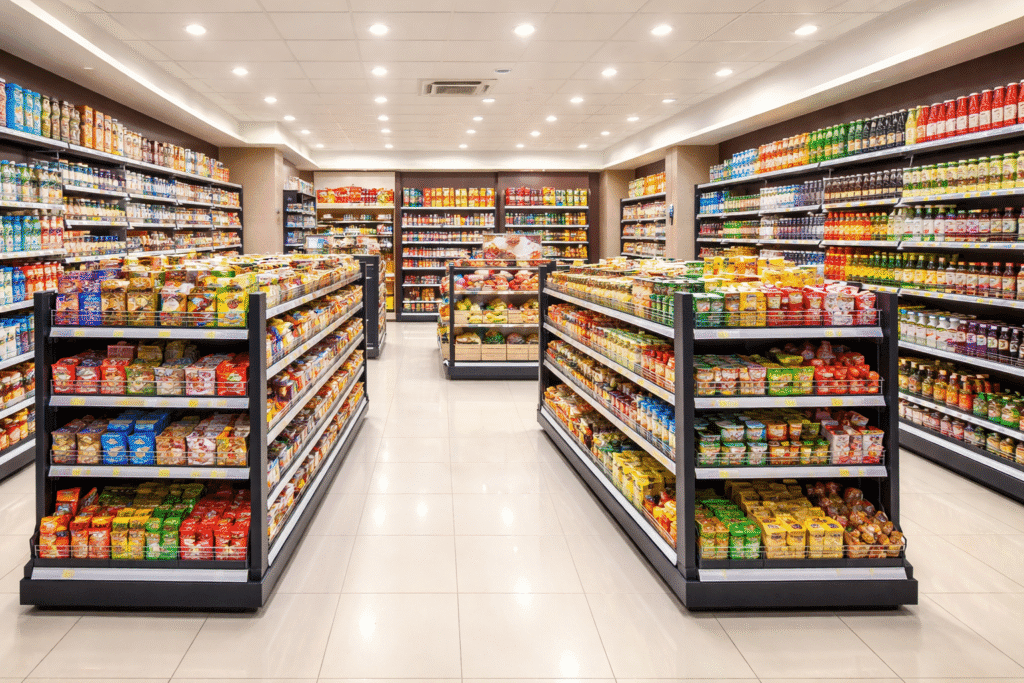
The grid layout arranges racks in straight, parallel rows from front to back. It is the most common Supermarket rack layout design used in large-format grocery stores, hypermarkets, and kirana upgrades. This format maximises shelf space, makes stock replenishment easy, and helps customers navigate predictably. It works best when you carry a wide range of SKUs and need maximum product density.
2. Loop (Racetrack) Layout
The loop layout guides shoppers along a defined path that winds through the entire store before returning to the exit. This format is ideal for mid-sized supermarkets that want to maximise customer exposure to all product categories. It is particularly effective for stores selling a mix of daily essentials and lifestyle products.
3. Free-Flow Layout
Free-flow layouts use irregular rack arrangements to create a browsing atmosphere. This is more common in specialty food stores, organic grocery shops, or premium retail formats. It encourages exploration but requires thoughtful rack placement to avoid confusion. Gondola racks for supermarkets work well in this format when paired with clear signage.
4. Spine Layout
The spine layout places a central main aisle running through the store with shorter aisles branching off on either side. It combines the efficiency of the grid with better visibility. This layout suits medium-sized grocery stores and supermarkets where a single dominant traffic path helps manage customer movement effectively.
Factors to Consider When Choosing Rack Layout
Before finalising your supermarket rack placement tips and layout plan, evaluate these practical factors:
Store Size and Floor Space
Smaller stores below 1,000 sq ft benefit from a spine or free-flow layout that avoids a cramped feel. Larger stores above 3,000 sq ft handle grid or loop layouts without creating congestion.
Product Categories
Group related categories together — dairy near beverages, snacks near billing counters, fresh produce near the entrance. Your rack layout should reflect how customers actually think when they shop, not just what is easiest for stocking.
Customer Traffic Flow
Most shoppers naturally move in an anticlockwise direction inside a store. Design your rack layout to support this movement, placing high-demand products along natural traffic paths and encouraging customers to travel deeper into the store before reaching them.
Visibility of High-Demand Products
Place everyday essentials such as rice, oil, and pulses toward the back of the store. This draws customers past other product categories, increasing exposure to items they might not have planned to buy.
Checkout Counter Placement
The area near billing counters is prime retail space. Keep it reserved for small, impulse-friendly products — confectionery, sachets, travel-sized items. Never block this area with heavy or bulky racks.
Safety and Aisle Spacing
As per standard retail store rack planning guidelines, maintain a minimum aisle width of 3.5 to 4 feet for comfortable customer movement and trolley access. In stores with heavy footfall, wider aisles of up to 5 feet prevent congestion and reduce the risk of product damage.
Best Rack Placement Strategy for Supermarkets
Knowing which rack type goes where is as important as the overall layout design. Here are placement strategies that work well for Indian supermarkets:
- Entrance displays — Use low-height, open display racks near the entrance for fresh arrivals, seasonal products, or promotional items. These create a strong first impression and set the tone for the shopping experience.
- Gondola racks for center aisles — Double-sided gondola racks are the backbone of any grid or spine layout. They offer maximum shelf space on both sides and are ideal for FMCG, packaged foods, and household products.
- Wall racks for heavy products — Mount sturdy wall-mounted shelving along perimeter walls to display heavier items such as beverages, cooking oils, and packed grains. This also keeps the central floor space open and accessible.
- Promotional racks near billing counters — Compact, standalone promotional racks placed near the checkout area are highly effective for impulse purchases. Update these displays regularly to keep the offerings fresh.
Common supermarket rack layout design Mistakes to Avoid
Even experienced store operators make avoidable errors during rack planning. Watch out for these:
- Overcrowded aisles — Filling every inch of space with racks makes the store feel suffocating. Leave breathing room for customers and shopping carts.
- Poor product category placement — Placing incompatible categories next to each other (cleaning products beside food items, for instance) confuses customers and impacts hygiene perception.
- Blocking customer movement — Never position standalone racks or display units at aisle intersections or near exits. These become trip hazards and disrupt traffic flow.
- Wrong rack height — Racks that are too tall obstruct sightlines across the store and make it difficult to locate staff. Standard gondola rack height of 5 to 6 feet works well for most supermarket formats. Reserve taller racks for wall sections only.
- Ignoring the decompression zone — The first few feet inside the entrance should be free of dense racking. Customers need a moment to adjust before engaging with products.
Role of Custom Supermarket Racks in Layout Optimisation
Off-the-shelf racks rarely fit every store perfectly. Store dimensions, ceiling heights, pillar positions, and product categories vary significantly — which is why custom-manufactured racks make such a practical difference.
Custom rack manufacturers work with store owners from the design phase itself. They evaluate floor plans, recommend layout configurations, suggest appropriate rack types for each zone, and manufacture shelving that fits the space precisely. This approach eliminates wasted space, ensures structural safety, and results in a layout that is visually cohesive.
Era Display Solutions is one such manufacturer based in India, specialising in supermarket racks, grocery racks, and complete retail display shelving systems. Their team works with supermarket operators, grocery chains, and independent store owners to plan and deliver customised rack solutions that align with store size, product range, and business goals.
Learn More: Complete Guide to Supermarket Rack Solutions
If you want a deeper understanding of rack types, materials, weight capacity, and complete shelving systems for retail stores, we recommend reading our detailed guide: Supermarket Rack & Grocery Rack: Complete Solution for Retail Stores. It covers everything from rack selection to store-wide shelving system planning.
Conclusion
Choosing the right Supermarket rack layout design is not just about aesthetics — it directly affects how customers shop, how much they spend, and how smoothly your store operates. From selecting the right layout type to placing each rack with purpose, every decision contributes to a better retail environment.
Start with your store’s dimensions and traffic flow, choose a layout that matches your format, invest in quality racking systems, and plan each zone intentionally. The right rack layout is one of the most cost-effective ways to grow your supermarket’s performance — and it all begins with getting the foundation right.
For stores requiring Supermarket rack solutions, manufacturer-designed supermarket and grocery racks can be tailored to store layout, product load, and space constraints. Retailers can explore custom rack options from ERA Display Solutions to achieve better space utilization, durability, and a professional retail display setup.
FAQs: supermarket rack layout design Planning
Q1. What is the best rack layout for supermarkets?
The grid layout is the most widely used and effective rack layout for supermarkets, especially in India. It maximises shelf space, simplifies navigation, and makes stocking and inventory management straightforward. For smaller or premium stores, a spine or free-flow layout can offer a better customer experience. Supermarket rack layout design
Q2. How far apart should supermarket racks be placed?
Standard aisle width between supermarket racks should be at least 3.5 to 4 feet. For high-footfall stores or stores where trolleys are commonly used, 5 feet or more is recommended. Narrow aisles below 3 feet create congestion and a poor customer experience.
Q3. Which rack layout increases sales in a grocery store?
The loop layout is particularly effective for increasing sales because it directs shoppers past a wider range of product categories before they reach the checkout. Combined with strategic end-cap displays and promotional racks near billing counters, this layout consistently drives higher basket values.
Q4. What rack height is ideal for supermarkets?
For central floor gondola racks, a height of 5 to 6 feet is ideal. This maintains sightlines across the store and keeps the space feeling open. Wall-mounted racks can go higher — up to 7 or 8 feet — for products accessed less frequently or for storage-display combination needs.
Q5. How do custom racks improve supermarket layout planning?
Custom racks are designed to fit your store’s exact dimensions, category requirements, and aesthetic. Unlike standard racks, they avoid space wastage, align with structural features like pillars and walls, and can be configured for specific product weights and sizes. Working with a custom rack manufacturer like Era Display Solutions ensures your layout is both functional and built for long-term use.