
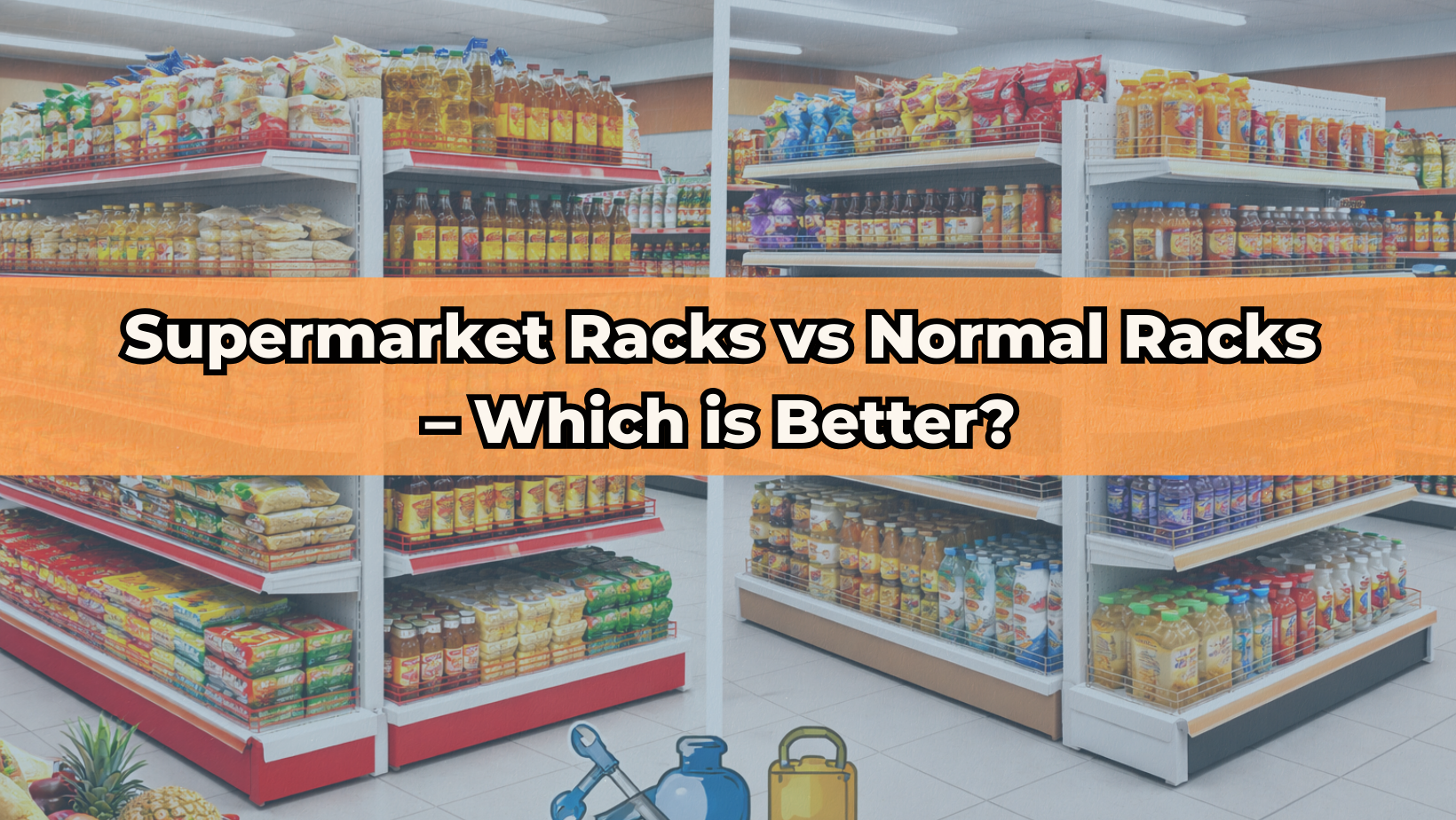
Walk into any well-run supermarket or hypermarket in India — from a D-Mart in Pune to a Reliance Smart in Chennai — and one thing immediately stands out: the shelving. Clean, uniform, fully loaded with products from floor to ceiling, the racks do far more than hold inventory. They define how shoppers navigate your store, how much product you can display, and ultimately, how much revenue you generate per square foot.
Yet one of the most common mistakes that new retail store owners make is choosing racks based on price alone. The result? Shelves that bow under heavy loads within months, wasted re-stocking time, and a store that looks disorganised to customers.
This guide gives you a clear, practical comparison between heavy duty supermarket racks and normal racks — covering load capacity, durability, adjustability, and long-term value — so you can make the right call for your specific business.
Walk into any well-run supermarket or hypermarket in India and one thing immediately stands out — the shelving. Clean, uniform, and fully loaded with products, the right Supermarket Display Racks do far more than hold inventory. They define how shoppers navigate your store, how much product you can display, and ultimately, how much revenue you generate per square foot. Yet one of the most common mistakes store owners make is choosing racks based on price alone — without checking material quality, load capacity, or long-term durability.
What Are Heavy Duty Supermarket Racks?
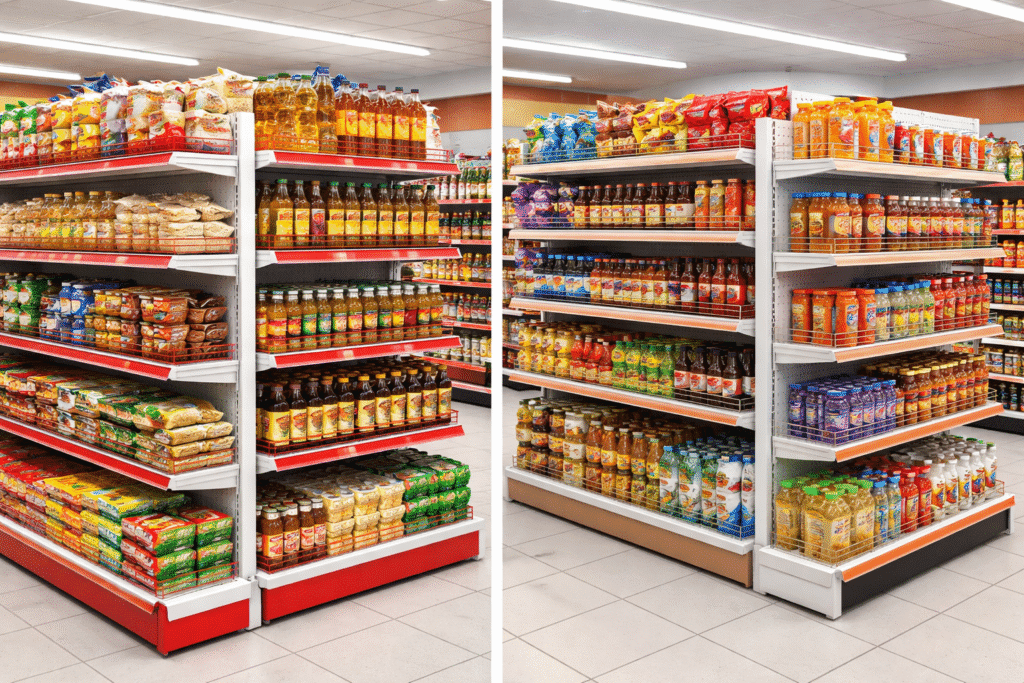
Heavy duty supermarket racks are purpose-built shelving systems designed to carry high product loads over extended periods without structural compromise. They are the backbone of modern supermarket shelving systems used in hypermarkets, cash-and-carry stores, and large-format grocery chains.
Key Characteristics
- Constructed from 18–20 gauge mild steel for maximum frame rigidity
- Powder-coated finish for corrosion resistance — critical in Indian humidity and temperature conditions
- Load capacity typically ranging from 300 kg to 500 kg per shelf level
- Height-adjustable shelves with multiple slot positions for flexible product display
- Available as gondola shelving (double-sided) or wall-bay units for perimeter display
These racks are the first choice for stores stocking beverages, packaged foods, household products, and bulk grains — categories where product weight is a constant operational challenge. Leading supermarket rack manufacturers design these systems to a 10–15 year service life under normal retail use.
What Are Normal Supermarket Racks?
Normal racks — often called light-duty or standard retail shelving — are the more basic end of the grocery store display rack spectrum. They are widely used in small kirana stores, boutique retail outlets, chemist shops, and convenience stores where product weight per shelf is relatively low.
Key Characteristics
- Lighter steel construction, often in the 22–24 gauge range
- Lower load ratings, typically 50–150 kg per shelf
- Simpler frame design with fewer adjustment slots
- Lower upfront cost, making them accessible to start-ups and small retailers
- Available in a range of sizes, though customisation options are limited
Normal racks work well when you are displaying packaged snacks, cosmetics, stationery, or small household items. The moment heavy packaged goods, bulk oil tins, or canned products enter the picture, these shelves begin to show their structural limits.
Key Differences: Heavy Duty vs Normal Racks — Side-by-Side Comparison
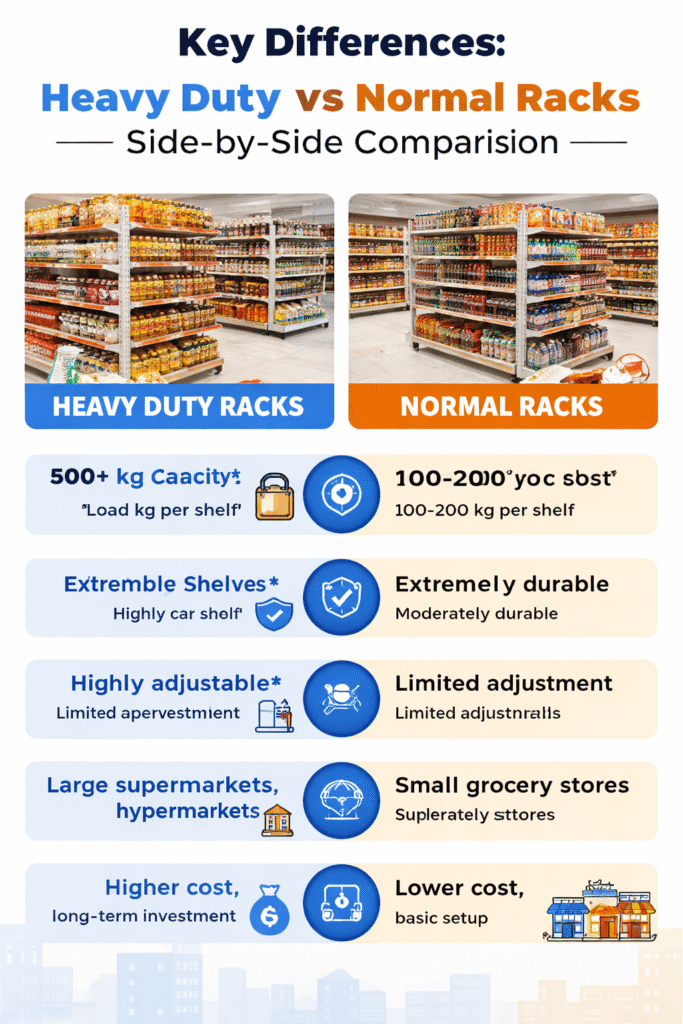
The table below covers the essential supermarket display rack comparison points that any store owner or retail buyer should evaluate before making a purchase decision.
| Feature | Heavy Duty Racks | Normal Racks | Winner | Why It Matters |
| Load Capacity | Up to 500 kg/shelf | 50–150 kg/shelf | Heavy Duty | Handles bulk FMCG, beverages, grains |
| Material | 18–20 gauge mild steel | Thinner steel / MDF | Heavy Duty | Resists bending under sustained load |
| Durability | 10–15+ years | 3–5 years | Heavy Duty | Lower replacement frequency |
| Shelf Adjustability | Multi-slot, tool-free | Limited / fixed | Heavy Duty | Adapt to SKU height changes easily |
| Store Size Suitability | Medium to large format | Small kirana/boutique | Depends on need | Match rack to store footprint |
| Initial Cost | Higher upfront | Lower upfront | Normal Racks | Normal racks suit tight budgets |
| Long-Term ROI | Excellent | Moderate | Heavy Duty | Fewer replacements, better display |
| Aesthetics | Professional, uniform | Variable | Heavy Duty | Improves shopper experience |
Benefits of Heavy Duty Supermarket Racks
1. Superior Inventory Organisation
When you are managing thousands of SKUs across a large store, consistent shelving matters. Heavy duty racks allow you to configure shelf heights to precise product dimensions, minimising wasted vertical space and making restocking faster and more systematic. Organised shelving also reduces shrinkage, as every product has a visible, designated home.
2. Long Lifespan Reduces Total Cost of Ownership
A quality heavy duty rack system built by a reputable supermarket rack manufacturer will serve your store for over a decade with minimal maintenance beyond occasional bolt checks and surface cleaning. Compare this to replacing lighter racks every 3–4 years, and the maths quickly favours the upfront investment.
3. Professional Store Appearance
Uniform, well-built shelving elevates the perceived quality of your store. Shoppers in India increasingly choose organised modern retail over cluttered alternatives. High load capacity racks hold products firmly and evenly, avoiding the sagging or tilting that can make a store look neglected — even when it is not.
Before placing any rack order, always create a basic floor plan showing aisle widths, gondola runs, and wall-bay positions. A standard Supermarket rack is the most widely used height format in Indian supermarkets and hypermarkets — it maximises vertical display space while staying within comfortable reach for both store staff and shoppers. Confirm ceiling clearance, lighting positions, and fire safety exit clearances before finalising rack heights for your store layout.
4. Higher ROI Through Better Product Display
Supermarket storage solutions that allow dense, well-organised product display directly impact sales. Research from organised Indian retail consistently shows that clear, accessible shelving increases impulse purchase rates. Heavy duty systems support more product facing per shelf, maximising the commercial value of every linear foot of retail space.
5. Adaptability for Business Growth
Adjustable shelf racks with multi-position slots let you reconfigure your store layout without replacing the entire shelving system. This is especially valuable when onboarding new product categories or responding to seasonal demand shifts — a common need in Indian grocery retail.
When Should You Choose Normal Racks?
Normal racks are not inherently the wrong choice — they are simply the right choice in a narrower set of circumstances.
- Your store is under 500 sq ft and stocks primarily lightweight packaged products
- You are operating a temporary or pop-up retail format with a planned short duration
- Your capital is tightly constrained and you are starting with a very limited SKU range
- Products stocked are predominantly cosmetics, stationery, or small FMCG packs under 1 kg
Even in these cases, it is worth speaking to supermarket rack manufacturers about mid-range options — there are products that bridge the gap between normal and heavy duty in both price and performance.
Expert Buying Tips
1. Always Verify Load Capacity Before Purchase
Ask the supplier for the rated load capacity per shelf and per bay. Reputable manufacturers will provide load-test certificates. Calculate your heaviest shelf scenario — for example, 10 x 5L cooking oil bottles — and confirm the rack exceeds that figure with a reasonable safety margin.
2. Evaluate Material and Finish Quality
Examine the steel gauge and the quality of the powder-coat finish. In coastal cities like Mumbai, Kochi, or Chennai, substandard coatings lead to surface rust within 12–18 months. Request a warranty on the finish and confirm the manufacturer’s in-house coating process.
3. Plan Your Store Layout First
Before ordering, create a basic floor plan showing aisle widths, gondola runs, and wall-bay positions. This ensures you order the right mix of rack widths, depths, and heights — avoiding costly returns or gaps in coverage. Most professional supermarket rack manufacturers in India offer free layout assistance for bulk orders.
4. Account for Future Expansion
If you plan to increase your store footprint or SKU range in the next three to five years, choose a rack system that can be extended. Good heavy duty gondola systems are modular — you simply add bays to an existing run without replacing what is already installed.
5. Compare Warranties and After-Sales Support
A competitive market means pricing is often similar across suppliers at the same quality tier. Differentiate on warranty terms — a 3-year structural warranty is the minimum you should accept — and on after-sales responsiveness. Ask for reference contacts from existing clients before signing a large order.
Frequently Asked Questions
Q1. What is the standard load capacity of heavy duty supermarket racks?
Heavy duty supermarket racks typically support 300–500 kg per shelf, depending on the manufacturer and steel gauge. Always verify the rated capacity with the supplier before purchase.
Q2. Are heavy duty racks worth the higher price for a mid-size grocery store?
Yes. If your store stocks beverages, bulk grains, or packaged FMCG products, the structural strength and 10+ year lifespan make heavy duty racks a sound investment with a clear ROI advantage over replacing normal racks every few years.
Q3. What is the best shelving system for supermarkets in India?
For Indian supermarkets and hypermarkets, powder-coated mild steel heavy duty gondola shelving systems with adjustable shelves are the industry standard. They withstand humid climates, support high SKU volumes, and comply with retail layout norms.
Q4. Can normal racks be upgraded to heavy duty later?
Generally, no. The frame and base design differ significantly. It is more cost-effective to plan for heavy duty racks from the start if you anticipate business growth, rather than replacing an entire shelving system mid-operation.
Q5. How do I find reliable supermarket rack manufacturers in India?
Look for manufacturers with ISO certification, in-house powder-coating facilities, and a portfolio of retail chain clients. Request load-test certificates and check warranties. Visiting a showroom or live installation site is always advisable before placing bulk orders.
Conclusion:
The answer depends on three factors: your store size, the weight of products you stock, and your investment horizon.
If you are running or planning a medium to large supermarket, hypermarket, or organised grocery store in India, heavy duty supermarket racks are the clear choice. They offer the structural reliability, professional appearance, and long-term ROI that a serious retail operation demands. The higher upfront cost is recovered over the lifespan of the rack — and in the quality of your in-store customer experience.
If you are operating a small neighbourhood store with lightweight product categories and limited capital, normal racks can serve you adequately for a few years. But build a replacement budget into your planning from day one.
For stores requiring Supermarket rack solutions, manufacturer-designed supermarket and grocery racks can be tailored to store layout, product load, and space constraints. Retailers can explore custom rack options from ERA Display Solutions to achieve better space utilization, durability, and a professional retail display setup.